Added 8/11/2008
Information extracted from EA documents as detailed below:
The Severn Catchment Flood Management Plan increases the risk or frequency of flooding.
Environment Agency - Severn Catchment Flood Management Plan - Draft Report [May 2008]
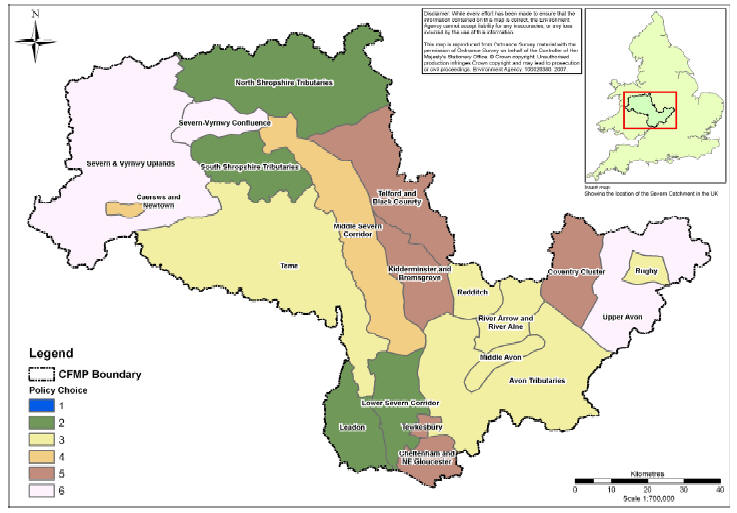
(Page 311) - Figure 6.2: The policy choices for each Policy Unit.
6.2.2 Policies
There are six pre-defined national policies provided in the CFMP guidance. These policies are
intended to cover the full range of long term flood risk management options. They set out the
directions flood risk management will take in the future, and help us achieve our vision for a
more sustainable, cost effective and natural approach to managing flood risk in our
catchments. The policies are shown in Table 6.2. These policies have been appraised for
each Policy Unit in the Severn CFMP. We have interpreted each policy by the type of
response likely to be required for their implementation in each Policy Unit.
Table 6.2: National policies for CFMPs
Number Policy
1
No active intervention (including Flood Warning and maintenance). Continue to monitor andadvise.
This option will increase flood risk. We may select this policy for natural catchments where the river is
connected to its floodplains and flooding has positive effects (for example, where it is good for habitats).
We may also select this policy where we recognise that the harm posed by flooding is not high, nor will
it be in the future. In these instances, we would not envisage costly interventions to manage low risks.
2
Reduce existing flood risk management actions (accepting that flood risk will increase overtime).
This option will increase flood risk. We may select this policy for places where current and future risks
do not warrant as much intervention (for example on maintenance of existing defences) and it is
therefore not worth continuing. Here, we can allow the risk of flooding to increase naturally over time.
Under this policy, where we have assets in place now, we would look at the options and timing of
withdrawing maintenance or retreating flood defences in our Asset Management Plans.
3
Continue with existing or alternative actions to manage flood risk at the current level (acceptingthat flood risk will increase over time from this baseline).
This option will allow flood risk to increase over time. We may select policy three where the risks are
currently managed appropriately and where the risk of flooding is not expected to increase significantly
in the long term. We may need to review if what we are doing currently is the best way of managing the
risk in the longer term, but we are confident that the risks do need managing. This policy may lead to
reviewing the Flood Warning services, or how we manage assets that may be in place.
4
Take further action to sustain the current level of flood risk into the future (responding to thepotential increases in risk from urban development, land use change and climate change).
This option will maintain the current levels of flood risk. We may select policy four in places where the
risk is currently managed appropriately, but risk is expected to rise significantly in the long term. In
these circumstances, we would need to do more in the future to reduce the increase in risks.
5 Take further action to reduce flood risk (now and/or in the future).
This option will reduce flood risk. This policy is about reducing the risk where the existing flood risk is
too high. We need to take action in the short term to reduce this level of risk.
6 Take action to increase the frequency of flooding to deliver benefits locally or elsewhere (which
may constitute an overall flood risk reduction, e.g. for habitat inundation).
This option will increase flood risk in places, but may decrease flood risk elsewhere. We can apply this
policy either locally to a flooding problem, or some distance away where flooding is not a problem.
However, the principle behind policy six is that we transfer flooding to places where it can bring benefits,
which reduces the risk in areas where it is a problem. This may mean that we can restore floodplains
and improve habitats, reducing the negative impacts of flooding elsewhere within the catchment. This
may also include changing the way we use the land to hold water within that part of the catchment for
longer, reducing flood risk elsewhere.
(Environment Agency - Severn Catchment Flood Management Plan - Draft Report [May 2008] - Page 246)
Link to Environment Agency web page http://www.environment-agency.gov.uk/commondata/acrobat/17_chapter5_and_6_2051317.pdf

