Rhys Blakely
in Bombay, and Joanna Sugden

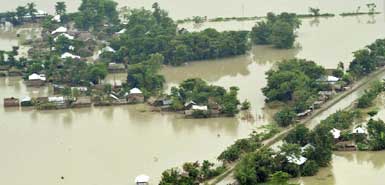
(Krishna Murari Kishan/Reuters)
More than 250,000 homes have been destroyed by the floods in Bihar India
 Image
:1 of 4
Image
:1 of 4
Two million people have been left homeless and scores killed by the worst flooding in India in half a century, amid allegations that river defences were neglected by corrupt officials.
The waters rose in the state of Bihar after the Kosi river, swollen by monsoon rains, burst an upstream damn in Nepal ten days ago. The waterway reverted to a heavily populated course it last flowed along 250 years ago, killing at least 55 people, destroying 250,000 homes and leaving thousands of acres submerged.
Manmohan Singh, the Indian Prime Minister, today called the floods "a national calamity" and announced £114 million in relief for the area. The death toll is expected to soar as water-borne diseases such as dysentery take hold. Food riots have already broken out in several areas.
Experts said that a river embankment in Nepal — for which the Indian government is responsible under a treaty between the two countries — failed on August 18 when the river was flowing at only about a sixth of the design capacity of the defence. Locals who noted that the river was about to breach the embankment three days before it did were ignored.
Himanshu Thakkar, of the South Asia Network on Dams, Rivers and People, a specialist think tank, said: "That the embankment failed when it did shows just how seriously ill-maintained it was."
He added: "We see this time and again: that money is allocated [to flood defences] but nothing happens on the ground. There are never any consequences. Government officials are unaccountable."
Villagers stranded in remote areas of Bihar were forced to resort to text messages in desperate attempts to summon help. One, from Sanjeev Kumar, a victim of the flood, read: "Time is running out for me and there is no relief in sight and I have not eaten for days."
The Ministry of Water Resources, the department responsible for the embankment's maintenance, did not respond to a request for comment. Officials have claimed that locals refused them entry to key sites.
Bihar, one of India's poorest states, sits just below Nepal in the northeast of the country. Some 247,000 acres of vegetables, wheat and paddy crops in the region have been destroyed by the deluge.
At least one person was killed in the Madhepura district as angry villagers fought over limited supplies of food and medicines at overcrowded relief centres.
Flood victims had looted grain at some places in Bihar, according to officials. Others ran for miles under helicopters that were dropping food packets.
One boy was killed and about 30 people were injured in Supaul district when food packets fell on them.
The UN children's fund UNICEF said that roads had been damaged and water and electricity supplies disrupted. Cases of diarrhoea and fever were reported in the 300 makeshift camps set up to deal with the emergency.
"The weather has been extremely hot, aggravating the suffering of the displaced population, particularly for children, pregnant and lactating women and the aged," UNICEF said
Several prisoners took advantage of the floods to escape from a jail in Supaul on Tuesday night.
"We are having difficulty in getting the exact number of prisoners who fled since communication networks have totally snapped," said Nitish Kumar, Bihar's chief minister.
Those displaced by the floods are not expected to be able to return home for another two or three months, when the embankment is repaired and the river returns to its normal course.
Engineers began repairing the broken dam on the Kosi river in Nepal on Wednesday to prevent it from causing further damage.
http://www.timesonline.co.uk/tol/news/world/asia/article4624947.ece
