'I warned ministers of extreme flooding'
By Richard Gray, Olga Craig,
David Harrison and Robert Watts, Sunday Telegraph
Last Updated:
1:51am BST 30/07/2007
Page 1 of 3
|
The view from Patricia
Purkiss's 600-year-old home in Tewkesbury is
normally a tranquil panorama of sheep
meandering across a meadow. Not, however,
this weekend. Since Gloucestershire was
lashed by the torrential rain a week ago,
the green fields surrounding her home have
been swamped by several feet of water. On
the other side of the torrent, a few hundred
yards from her garden gate, stands an
anonymous brick building.
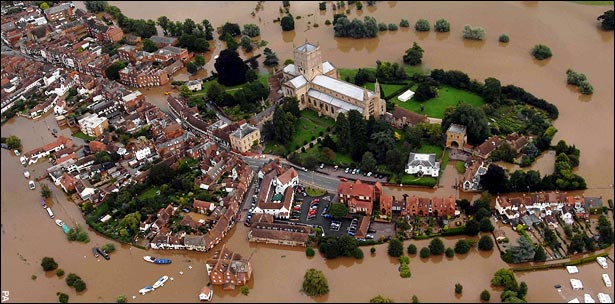
|
| British
isles: Tewkesbury, after the town
was cut off when the Severn and Avon
rivers burst their banks
|
"That," she says angrily,
jabbing a finger at the building from the
doorway of her flooded home, "is the water
treatment works. They built it on a flood
plain and, despite all the talk of climate
change and heavy storms, they failed to
protect it. So now our homes are flooded, we
are surrounded by water… and we don't have a
drop to drink because the place that is
supposed to clean the water is flooded too.
It's stupid and it makes me absolutely
furious.
"Frankly, if the head of
Severn Trent water company stepped into my
house today, I'm telling you, he would not
get out alive."
Like many of the 350,000
in Gloucestershire who are still without
water, and the thousands who have no
electricity either, Ms Purkiss is furious.
So doubtless she will be less than impressed
with the announcement yesterday by Lady
Young, the head of the Environment Agency,
that water bills must rise - to pay for
protecting water plants and electricity
stations from the kinds of severe floods
that have left great swathes of middle
England under water in the past fortnight.
The cost of flood-proofing
our towns and cities, Lady Young insists,
will have to come from increased bills. "You
either pay upstream to prevent or you pay
downstream to mop up, but you've got to
pay," she says. "Climate change is coming
home to roost."
Monsoon-like conditions
have done £5 billion of damage to 50,000
British homes and businesses this summer.
And the truth of the matter is that, despite
a host of warnings, Britain was woefully
ill-prepared for the tidal wave that
engulfed it. Consumers are expected to foot
the bill for flood prevention measures, yet
the water companies have failed to invest
enough in infrastructure, such as drainage
systems, which could have lessened the
impact.
This has made a difficult
situation for the flood victims all the
harder to bear, expecially coupled with the
facts that:
• almost half of Britain's
flood defence systems are not up to the
required standard;
• funding for these
systems is almost £200 million below
necessary;
• the Government has been
warned repeatedly that the UK does not have
the capacity to respond to a major flood;
• fire fighters and Armed
Services were initially forced to stand idly
by while agencies squabbled over who was
responsible for what.
Perhaps the most worrying
aspect has been the lack of funding. Under a
deal with the industry regulator, Ofwat, the
water companies were supposed to spend £4.3
billion on infrastructure in 2005-2006.
Instead, in a cost-cutting exercise, they
invested only £3.4 billion.
What is even more
staggering is that since 2000 there have
been 25 separate reports from government
bodies and parliamentary committees advising
how to reduce flood risks and the way they
are handled. Yet despite this, the National
Audit Office has revealed that only 57 per
cent of Britain's flood defence systems are
in ''target condition''.
It has all contributed to
the current chaos and confusion: made all
the more infuriating by the fact that when
floods last created chaos, in the autumn of
2000, the shambolic response was heavily
criticised by the Department of Environment,
Food and Rural Affairs, which said such
mismanagement could only be resolved in
future by giving overall responsibility to
the Environment Agency. It was never done.
As Ed Gallagher, who was
chief executive of the agency from 1995 to
2000, observes wryly: "The fact is that
funding for defences ebbed and flowed
according to the bad headlines. When
flooding disappeared off the news agenda,
funding was cut. |
|
"When John
Prescott told me
in 2000 that
funding would be
increased, I
told him it
wouldn't be
enough. The
events of the
past few weeks
would not have
been as serious
if the
Environment
Agency had had
the resources it
needed. And it
has not been
made into a
co-ordinating
authority."
A brief history
of the situation
makes miserable
reading. It
began with storm
clouds sweeping
across the
south-east of
England. The
heavy downpours
caused transport
chaos in London
and the
surrounding
area. As the
storm moved
west, it slowed,
pouring torrents
of rain on to
Gloucester,
Cheltenham and
Worcester. In
Evesham, one of
the
worst-affected
areas, 60 people
had to be
airlifted to
safety and more
than 70 special
needs pupils and
teachers were
stranded for two
nights as roads
were cut off.
Thousands of
motorists had to
abandon their
cars as
motorways turned
to fast-flowing,
6ft-deep rivers.
With more water
cascading down
real rivers,
Tewkesbury was
overwhelmed at
the point where
the Avon meets
the Severn. The
rising waters
then flooded a
water treatment
works in Mythe,
near Gloucester,
leaving
thousands
without water
before
threatening to
swamp an
electricity
substation.
Initially,
Britons faced
the destruction
and devastation
with their
accustomed
stoicism. There
was an abundance
of community
spirit: an aura
of "let's all
pull together".
But when
communities such
as Hull, where
10,000 homes
were wrecked,
were left to
fend for
themselves and
looters and
cowboy builders
swiftly took
advantage of
vulnerable
householders,
that quickly
dissipated.
Almost five
weary weeks
later those
affected in that
city are now
furious at how
ill-equipped the
councils, water
companies and
the EA were to
deal with the
deluge.
The floods that
hit Hull, and
the chaos that
ensued, should
have sounded
warning bells.
They didn't. Two
weeks ago, in
the days before
the downpours
that heralded
the floods in
Gloucestershire
and
Worcestershire,
forecasters at
the Met Office
monitored the
building storms.
They issued an
official warning
of the impending
weather to the
EA on Wednesday
July 18, a full
two days before
it hit.
From the
agency's
headquarters in
Bristol,
officials were
able to watch
real-time radar
images that
charted the
progress of the
storm clouds as
they spiralled
towards the UK
and then moved
across the
country, dumping
torrents of
water in their
wake. But
despite this
early warning,
the EA failed to
predict the true
extent of the
floods and
mobilise
defences in
time. What
ensued was a
bungled attempt
to do too
little, too
late.
Hotel owner Nick
Mossop, for
example,
landlord of the
Swan Hotel in
Upton upon
Severn, was told
by the
Environment
Agency on the
Wednesday before
the storm that
temporary flood
barriers were on
their way. The
next day he was
told the
defences were
now on their way
from
Kidderminster
and would be in
place by Friday
morning. But by
Friday
afternoon, as
the worst of the
storm hit, the
barriers had
still not
arrived.
Ironically they
were stuck on
the motorway -
in the floods
that blocked the
roads to the
town.
Flood defences
also failed to
reach areas of
Gloucester when
the lorries
transporting
them became
bogged down. It
was the second
time in a month
that the
Environment
Agency had
failed to put up
the moveable
steel flood
barriers to
protect the
city.
It is little
wonder, then,
that as the
water begins to
settle, the
initial shock
felt by people
like Mr Mossop
has turned to
anger. In the
Swan Hotel,
which he owns
with two friends
and which he
refurbished
earlier this
year at a cost
of £150,000,
litter floats
listlessly
through the
oak-beamed bar.
Normally, the
riverside pub
would be
bustling with
customers, but
four feet of
stinking,
sewage-filled
water - at one
stage 6ft deep -
now floods it.
He blames the
EA's tardiness
with the
barriers.
"We have lost
everything that
made our hotel
what it was,"
said Mr Mossop.
"All the chairs,
tables, fittings
and kitchen
equipment are
ruined. There
are a lot of
angry people
here in Upton
upon Severn.
They promised to
have the
temporary flood
barriers up but
they didn't and
now they are
telling us that
they would not
have held back
the water
anyway, but they
didn't know that
at the time.
"It could have
bought us a day
to start moving
stuff like
kitchen
equipment out."
He is not alone
in his anger
over the
slowness of the
operation. Prof
Ian Cluckie,
chairman of the
government-funded
Flood Risk
Management
Research
Consortium and a
hydrology
researcher at
Bristol
University, saw
the warning
issued by the
Met Office and
believes it gave
ample warning of
the weather to
come. |
|
The storm, unusually, dumped a lot of water downstream, at the bottom of the catchment area for the Severn and Avon rivers. It then moved upstream, raining all the time and causing more water to run into the affected areas, topping up the floods. The Environment Agency was caught out, he believes, as its plans were designed to cope with more conventional flooding.
"It should have been very clear what the nature of the storm was going to be,'' he says, "yet they seem to have been unable to adapt to an unusual situation. Normally you would have water coming downstream giving you a day or a couple of days' notice before it hits the larger towns and cities. But on this occasion it filled up the bottom of the river first and then topped it up from further upstream."
The problems have been exacerbated by the confusing patchwork of who is responsible for what. While rivers and the coastline are the responsibility of the Environment Agency, drainage is in the hands of local authorities and water on main roads is the remit of the Highways Agency. Private water companies are also responsible for sewer flooding. Thus, no single body is charged with preventing and managing flooding, even though drains, sewers and rivers all contribute to flood risks.
Although flood defences have been built up over the years, under-investment in the drainage systems and poor management of minor brooks and streams have created a weak spot. Residents of Tewkesbury and Evesham, two of the worst-hit areas, reported that street drains were heavily blocked with debris and litter. And rescue workers say horrendously-blocked culverts and conduits diverting streams under roads and bridges contributed to the devastation. In the village of Dunley, in Worcestershire, one stream under a bridge was so blocked with branches, leaf litter and mud that the water building up behind it tore away the bridge wall and the gable end of a house.
Ed Gallagher insists that he had warned the Government that more investment in flood prevention was needed. "During my time at the Environment Agency, I warned ministers that flooding was getting more and more extreme. We said that more investment was needed, not just on defences but on research and development."
The fact is that funding for flood defences across the country has changed little over the past five years. It rose slightly in 2005 and fell back sharply this year. According to the insurance companies the current £570 million spent needs to be increased to £750 million. Admittedly Gordon Brown has promised the figure will rise to £800 million - but not until 2011.
The vast shortfall is seen by many as symptomatic of how little thought the Government has given to flooding. And yet the information has been known and the warnings ignored. Two years ago a report published in the wake of a simulated flooding exercise revealed serious flaws in the country's responses and another, produced by the Chief Fire Officers Association, also in 2005, warned that the UK "simply does not currently have the capacity to respond to a major flood event". It criticised the confused command structure and called for the fire and rescue services to be given a lead role in such emergencies. But according to the report's author, Paul Hayden, chief fire officer for Hereford and Worcester Fire Service, few of its recommendations were acted upon.
"It would only require a £5 million one-off investment to establish the nationwide resources we need, but frustratingly floods have been largely overlooked," he says. His report also warned that the protection of water treatment works and electrical generators should be a priority.
The Government repeatedly warns Britons of the threat from climate change, and is determined to build three million new homes - with lax planning laws allowing them to be built on flood plains, leaving them uninsurable. It seems evident that the need for coherent, workable flood defences is essential.
Even then, it will all be a bit late for the residents of Gloucestershire who, this morning, are braced for more devastating floods after yet more heavy rainfall. Mark Williams and his family, from Newtown, near Tewkesbury, already face nine months out of their home and are trying to be sanguine about further trouble.
''I don't see how another flood can do any more damage than we have already suffered anyway,'' he says. |
|
|
|