|
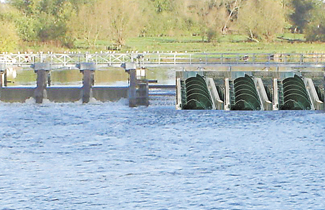 PLANS to install a hydro electric generator on the weir adjacent to
Goring Lock are being tested with a series of environmental surveys.
PLANS to install a hydro electric generator on the weir adjacent to
Goring Lock are being tested with a series of environmental surveys.
The Goring and Streatley Sustainability Group is hoping to obtain
permission from the Environment Agency to build three Archimedes Spirals
to naturally generate power from the flow of the river.
The spirals, of which there are currently three active in Britain, are
designed to allow fish and eels to easily swim through them. The river
water moving down the weir turns the spirals and would generate £100,000
worth of energy a year at today’s prices.
Cllr David Holt, chairman of the parish environment and community
committee and member of the sustainability group, said the plans were
moving along smoothly with public support.
“Some of the environmental surveys had to be carried out in June because
of breeding patterns and so far we haven’t found any issues with species
that would be particularly disturbed. We hope that these surveys will be
completed by October,” he said.
“The response to these plans has been overwhelmingly positive. In fact,
most people ask ‘why didn’t we do this 20 years ago?
“There’s an enormous amount of power moving along that river all of the
time and we would be foolish not to take advantage of it.”
Once operational, the spirals will generate power for the Swan in
Streatley during the day, before powering the local grid in the
evenings.
Theoretically, the spirals will also cut down on the 60 per cent losses
of power through traditional generation, meaning nearly all of the power
created will go directly into the village’s grid.
The group is currently working to raise the approximate total of £1.1
million required to install the spirals. Sustainable development funds,
as well as both Goring and Streatley parish councils, have given
financial support.
“With impending price increases, once they are installed, the spirals
should pay for themselves in 10 years,” said Cllr. Holt.
“We may have a shortfall in our funding and if that’s the case then we
might allow people to buy shares in the project.
“It is most important to us that the revenue generated from the power
source feeds right back into the village, rather than elsewhere.”
If all goes according to plan, the spirals should be installed in the
next two years.
“When I started planning this in 2005, I wanted to see it finished by
2010. At the moment we are on schedule. Once it is installed it will be
up and running and generating power straight away,” said Cllr. Holt.
Published on 04 August 2008
|


